Copyright © TMS Global
TMS Global
PO Box 936559
Atlanta, GA 31193-6559
800.478.8963
Our EIN number or Taxpayer Identification Number is 58-1546441.

Name
Choose Password
Retype Password
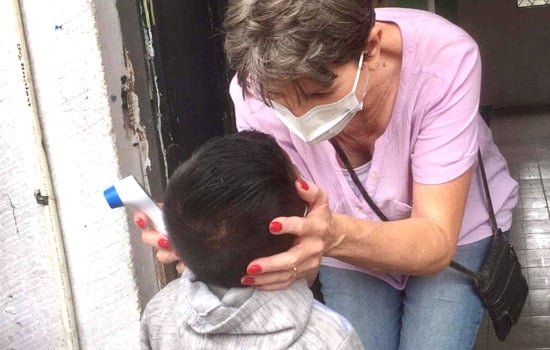
“I am just as average and ordinary as they come.”
Sharon Nichols wants you to understand that before she tells you anything else.
She was perfectly happy with her life in Columbia County, Georgia. Then, as Sharon puts it, “God sent us over here.”
“Over here” is Ecuador, where Sharon and her husband, Graham, TMS Global cross-cultural workers, have served for years. Among the children they came to know there was a boy named Derek.
Before the pandemic, Derek and his siblings were part of Sharon and Graham’s ministry.
Then, in early 2020, Sharon was sitting in a little restaurant with her Vacation Bible School team, preparing for VBS to begin the next day.
The pastor arrived late.
“I have to tell you something,” he said. “The government’s shutting us down because of this COVID virus. We can have nothing. We can do nothing. We’re going home. Let’s just pray about it.”
Sharon remembers wondering how long it could possibly last.
A week? A month?
“That was almost two years.”
In Ecuador, COVID restrictions were severe. People could drive only on certain days based on their license plate numbers. Shopping was restricted. Supplies became difficult to find.
For Sharon, the problem quickly became impossible to ignore.
“We’re having a hard enough time, and we’ve got money,” she remembers telling Graham.
They could pay a little extra to have water delivered to their cistern. They knew whom to call for gas. They had the money to buy groceries when they could get to them.
“People that live here know it too, but they don’t have the $4 to pay for it.”
Before the pandemic, some of Sharon’s neighbors survived by buying a bag of candy and selling the pieces on the street for a dime apiece. Others were earning around $10 a day doing general labor. When the government ordered people off the streets, that income disappeared.
Nobody came to Sharon asking for food.
She didn’t need them to.
“I know them. I’ve been to their houses. I’ve been to their communities. I know what they need. They’re not asking me, but everybody’s gotta eat.”
Sharon contacted churches and supporters with one simple request: “We gotta have the money. We gotta have the money.”
She and Graham decided they would work with whatever came in.
“What we’ve got is what we’ll spend,” Sharon says.
And people gave. Gifts arrived through TMS Global from churches and individuals who wanted to help families weather the crisis.
Their gifts of cash turned into food kits. Each kit included a 25-pound bag of rice, oil, eggs, bread and dried beans—“stuff that they can turn into soups,” Sharon says.
So every food kit represented someone else’s decision to participate. People thousands of miles away gave. A local store assembled the orders. Sharon worked on getting the food to the families.
First, she needed permission to leave her house.
So she wrote to the government. Her letter got straight to the point: “Look, y’all ain’t helping these people.”
She was respectful, she says, but she wasn’t interested in dancing around the problem.
“I can’t help everybody. But God has given us this group of people that we have been serving since 2014. We can help them.”
Permission came quickly. Once a month, Sharon and her ministry team could go out and deliver food.
They loaded the van and went from community to community.
And those vans were full of food.
“We had to get in the van and set the food kits on top of us. I don’t know how we did it. We sang, we prayed, we thanked God, we had a mini devotion. We gave the bags. They hugged, they cried.”
Sometimes there was extra food. Sharon prayed there would be. Along the way, she might see a family on the street, a mother nursing a baby with a two-year-old sitting nearby crying.
“They got the extra food because God put them in my path. That’s how we looked at it.”
Derek’s family received a kit too. They needed it.
By then, Derek had developed a brain tumor. His family wasn’t working, and there wasn’t enough food for the children. Normal church activities had stopped, but the relationship hadn’t.
“We stayed in contact with them, and we prayed for them with the food deliveries,” Sharon says.
Much of the rest of their ministry had moved to Zoom. Even from a hospital bed, though, Derek listened.
His mother stayed with him, begging God to heal her son. She was pregnant at the time. Sharon remembers that she hadn’t been to a doctor, wasn’t taking prenatal vitamins, and wasn’t eating well.
Then Derek died.
His mother was grieving her son while carrying another child, a girl.
“She told me, she said, ‘Sharon, I don’t want her.’”
Sharon answered her. “Look, she’s not a replacement for Derek, but God gave her to you.”
After Derek’s death, with Sharon’s encouragement, his mother went to the doctor and began caring for herself during the pregnancy.
Then one day she called Sharon again.
“Sharon, I’ve never had a girl. I don’t know what to do. Do you have any names?”
Sharon, who only has sons, gave her some ideas. A couple of weeks later, Derek’s mother asked Sharon for her full name.
About a week after that, she called again.
“Sharon, I’m going to send you a picture. I want you to come meet Ashley Rose.”
Rose is Sharon’s middle name.
The people who gave money for food during the pandemic couldn’t have known where every bag of rice would go. They couldn’t have known that one of those food deliveries would help keep Sharon connected with a mother watching her son die.
Eventually, the pandemic restrictions eased. By then, however, gangs had gained power in communities already struggling to recover. Curfews shut things down after dark.
“There’s no traveling. There are curfews. There’s no work. There’s nothing,” Sharon says.
Some people who once worked eight hours a day could find only four. Families still had rent to pay and children to feed.
School added another expense.
“There’s a list of school items needed that would blow your mind,” Sharon says.
A uniform. A PE uniform. School shoes. PE shoes. A hygiene kit. Toilet paper. School supplies. Altogether, it can run $150 to $200, depending on the child’s grade.
“They can’t pay the $4 water bill,” Sharon says.
Children who don’t have the required school items can’t attend.
And once they’re there, many bring their own food.
“You can’t learn on an empty stomach,” Sharon says.
Schools use the same buildings for several shifts of students. Younger children may attend from 7 a.m. to noon; high school students can attend from 6 to 11 p.m.
For those older students, the trip home comes during the hours when gang violence has made travel especially dangerous. Sharon says soldiers have been stationed outside schools to help students get safely in and out.
The pandemic food program never ended. Supporters continued giving, and Sharon and Graham continued buying food for families they knew.
Years after those first food kits went into an overloaded van, Ashley Rose is still there.
She comes to Sunday school every Sunday. She sits in the same seat where her brother Derek sat before the pandemic.
“She hugs me and tells me she loves me,” Sharon says, “and she always knows her monthly memory verse perfectly.”
People have asked Sharon why she and Graham stayed through the pandemic and everything that followed.
“I always tell them the first thing that comes to mind is Ashley.”
Sharon knows she can’t say what would have happened had she and Graham returned to the United States. But she knows that staying allowed them to remain close to Derek’s family when his mother needed someone she trusted.
“Had I gone back to the United States, had Graham and I left, I don’t know that she would have contacted me about that.”
The same can be said about the people who gave.
They couldn’t stay in Ecuador because most of them weren’t there.
They could help Sharon and Graham stay.
Sharon posts pictures of the ministry because, she says, “people need to see what we are doing.”
“Not to say, ‘Well done,’ but to see what God can do through the average and ordinary.”
Sharon is talking about herself.
She could just as easily be talking about the people who gave.
Join ordinary people doing extraordinary Kingdom work.
Pray. Give. Go. Find your place in God’s work across cultures.
Copyright © TMS Global
TMS Global
PO Box 936559
Atlanta, GA 31193-6559
800.478.8963
Our EIN number or Taxpayer Identification Number is 58-1546441.