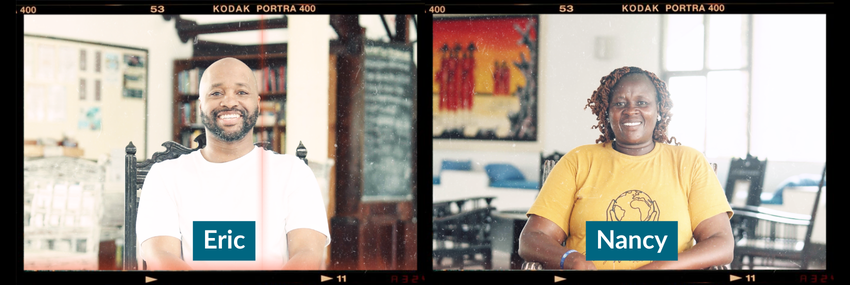
Dr. Eric Gill’s seven-year-old son had been complaining for a week that his leg hurt.
“You just want to skip karate class,” the Oklahoma pastor and seminary leader told him. “That’s not okay. You have to push past the fatigue and the pain.”
But the pain didn’t go away.
That afternoon, Eric and his wife were at the hospital, watching a team prepare their second grader for emergency surgery.
Thousands of miles away, Pastor Nancy Wambui was moving just as fast. A Kenyan pastor and cross-cultural worker in a rural part of her country, Nancy always had someone to visit, something to fix, or someplace to be.
“I was a busy pastor… running here and there,” she said. “I didn’t have time for myself or my family.”
Rest wasn’t part of her rhythm.
Pain was.
Nancy had learned to push through it. For a long time, pushing was enough to keep both Eric and Nancy running the race of faith.
Until one day, it wasn’t.
While his son recuperated at home, Eric skipped TMS Global’s Thrive conference in Cape Town to keep the boy from jumping, running, or even skipping for six weeks. Cape Town would have been easier.
But everything wasn’t going wrong—or so it seemed.
The high school basketball team Eric coached in his “spare time” won the state championship. The players were over the moon. One more good reason to keep pushing, right?
Three weeks later, one of those players died in a car accident. Eric found himself not only pastor to his church members and caregiver for his son but chaplain to a grieving team.
Then, a message arrived. Eric had been selected as one of the top 40 emerging leaders in the Black church. He was invited to a celebration in Baltimore. Not exactly Cape Town but a recognition that all his hustle was paying off.
While shopping in Baltimore, his wife suddenly began to struggle for breath. Just walking from shop to shop, she sounded like a marathon runner. When the plane, which made the trip to Texas at a record speed of 2 hours and 45 minutes, finally landed, she needed a wheelchair just to get off.
“Bilateral pulmonary embolisms (blood clots in both lungs) and critically low hemoglobin,” the doctor told them. “Glad you weren’t on the plane any longer. Another 20 minutes could have been fatal.”
Now Eric had a son recovering from surgery, a grieving team, a church to lead, and a wife undergoing bone marrow tests and cancer screenings.
When his daughter asked to play, he gave the only answer he had: “Daddy’s tired.”
Then his back erupted in dark brown and purple patches.
He didn’t know what it was.
Eric wasn’t energized. He was in pain. The rash on his back got worse, so he called his mom.
“Honey, you have shingles,” she told him. Eric called his doctor. She told him to expect 2-4 weeks of flu-like symptoms before the blisters on his back burst and crusted over.
Shingles! Eric thought. Just what I needed on top of everything else.
As part of the Thrive program, Eric had a life coach and a therapist. Wearing a loose shirt that wouldn’t rub against his back, Eric called the coach, whose name was Warren. “Who cares if you burn out?” Warren asked.
Eric forced himself to sit with that question. Who would care if I burned out?
He didn’t have an answer.
Slated to attend the same TMS Global Thrive conference in Cape Town, Nancy arrived in South Africa exhausted.
One day, she and her group visited the prison where Nelson Mandela had been held during his incarceration, now a UNESCO World Heritage Site. During Nancy’s visit, an ex-prisoner who had been held at that location spoke.
“You cannot be a leader without an education,” the man told the visiting missionaries and pastors.
His comment lodged in Nancy’s heart. It tugged at her mind while she was at the site, on the bus back to the hotel, on the flight home, and on the road north from Nairobi.
In the former prisoner’s words, God’s message reached Nancy: Go to school.
After she returned home, both Nancy and her husband enrolled in a university, pursuing bachelor’s degrees in theology. As part of the Thrive program, Nancy had access to a coach, a counselor, resources, and peers from across Africa and North America. She wasn’t alone.
Nancy didn’t need to leave ministry or even take a break. What she needed was thorough preparation. And since she was already in ministry, she could put it into practice right away.
Instead of helping the next person who asked, Nancy began to investigate what the community really needed and what her church could do to help.
Soon, she saw the issue she could help address:
Alcohol and drug addiction.
Instead of spreading herself across everyone’s needs, Nancy had identified her unique calling and ministry.
Soon, a recovery group formed.
And instead of feeling exhausted, Nancy was energized.
"You can live your life from one of three categories,” Warren told Eric. “You can live the selfish life, the selfless life, or the self-true life. Which one are you living?”
At first, Eric didn’t like where that conversation went. He had always seen himself as selfless, always available, always saying yes, never drawing lines. That was the kind of life he thought God honored and that other people praised.
When his daughter asked him to play, and he answered (again), “Daddy’s tired,” he understood.
The more he sat with Warren’s question, the harder it was to ignore the truth that lay underneath. His “selflessness” wasn’t just generosity. It looked spiritual. It even felt spiritual. But it wasn’t sustainable.
Eric started protecting space on his calendar. Meetings didn’t automatically stack anymore. When something ended, he didn’t rush to fill the gap.
At first, the silence felt wrong.
Then it started to feel like margin.
And eventually, it felt like rest.
By the time he boarded the plane to Kenya for his Thrive graduation, Eric wasn’t running at the same pace. He wasn’t trying to prove himself. For the first time in a long time, he felt present.
Nancy noticed it, too.
Her own journey had taken a different shape. It started with a statement that wouldn’t leave her alone—you cannot be a leader without an education. Those words had followed her home, into her work, into her prayers. Through Thrive, she began to see that formation wasn’t optional. It was the foundation of ministry.
Eric and Nancy weren’t the only ones who were changed.
Around them, other Thrive graduates carried their own pressure, their own realization that something had to change. This cohort of 23 participants had walked the same path together.
Graduation was at the beach and filled with music and traditional Kenyan food. It was a celebration of thriving in ministry, not because they learned new tactics, but because they became more deeply formed people.
And the next time Eric’s daughter asked to play, he didn’t give the same answer.